
Mississippi Highway Patrol Arrests
The Highway Safety Patrol serves as the Department of Public Safety's statewide patrol arm. Its history starts with Senate Bill 161. The bill was signed April 1, 1938. Today the Enforcement Division runs nine troops. Those troops enforce state and federal traffic laws, make arrests, and assist local law enforcement. Troopers also handle impaired-driving cases, traffic offenses, and wanted-person matters on the roadways.
The Patrol's job ends at the roadside. It can investigate an incident or announce an enforcement action, but county sheriffs hold the booking records. No statewide roster exists for MHSP bookings. A news item may name a person or describe an arrest. Booking date, bond status, release, and any booking photo stay with the county that accepted the person.
The DPS Highway Patrol page gives the agency's official name and public mission. Names matter in a search. The Patrol's descriptive history leans on MHSP. MHP shows up across divisions, district offices, and report materials instead. Search both when hunting arrest news. That split in abbreviations trips up many searches.
Where MHSP Arrest News Appears
Start statewide with the DPS News Archive. Its releases cover the Highway Patrol, the Mississippi Bureau of Narcotics, the Mississippi Bureau of Investigation, and joint operations. It is event-driven news, not a daily arrest roster. The Public Affairs Division handles current press releases and public education on highway safety. Different DPS sources answer different questions. The table separates event news from material that describes statewide programs or data.
| Official source | What it can show | How to read it |
|---|---|---|
| DPS News Archive | Selected arrests, investigations, enforcement actions, and joint operations. | Search for a named operation or event. Coverage is selective, with no promise that every arrest is announced. |
| Public Affairs Division | Press releases and public education on DUI, seat belts, distracted driving, motorcycles, and ATVs. | Useful for official announcements and campaigns, not individual custody status. |
| DPS Public Data portal | Public Arrest Data, Citation Data, and Crash Data. | Use it for statewide context and trends. It is not a live name-and-photo search. |
| Highway safety program pages | Impaired-driving and traffic-enforcement programs. | These describe enforcement work but do not replace a booking record. |
The DPS News Archive posts dated release cards. That works for confirming a reported event. It is not a full MHSP arrest log.
Silence in the archive proves nothing. The agency's news threshold and the county's booking process operate on separate tracks. A release may also describe a joint operation rather than an MHSP-only action. Read the details closely. Note the lead agency and county. Watch the verbs: arrested, charged, or only investigated. For a booking status or a copy of the record, a county roster or records custodian is still the place to go.
MHSP Troops Across Mississippi
Nine troops split Mississippi's patrol coverage. The district-office map divides them across the northern, central, and southern parts of the state. It points to the regional office tied to an event. Custody still depends on where the person was booked. The county groupings below follow the official district-office page. No troop number is inferred from list order.
| Region | Counties shown for this troop area |
|---|---|
| Northern | Bolivar, Carroll, Grenada, Holmes, Humphreys, Leflore, Montgomery, Sunflower, and Washington. |
| Northern | Coahoma, DeSoto, Lafayette, Marshall, Panola, Quitman, Tallahatchie, Tate, Tunica, and Yalobusha. |
| Northern | Alcorn, Benton, Itawamba, Lee, Pontotoc, Prentiss, Tippah, Tishomingo, and Union. |
| Central | Claiborne, Copiah, Hinds, Issaquena, Madison, Rankin, Sharkey, Simpson, Warren, and Yazoo. |
| Central | Calhoun, Chickasaw, Choctaw, Clay, Lowndes, Monroe, Noxubee, Oktibbeha, Webster, and Winston. |
| Central | Attala, Clarke, Jasper, Kemper, Lauderdale, Leake, Neshoba, Newton, Scott, and Smith. |
| Southern | Covington, Forrest, Greene, Jefferson Davis, Jones, Lamar, Marion, Perry, and Wayne. |
| Southern | George, Hancock, Harrison, Jackson, Pearl River, and Stone. |
| Southern | Adams, Amite, Franklin, Jefferson, Lawrence, Lincoln, Pike, Walthall, and Wilkinson. |
The MHP district-office page holds the troop map and office locations. Its landing page points visitors to the regional map.
Use the official map to find the patrol district. Then use the county directory to find the jail or sheriff holding the booking record. Coverage maps have limits. They are not custody lookups. An incident can cross a county line, or a person can be booked in a different county entirely. The receiving jail's record controls in those cases. A troop office identifies the patrol area, while the sheriff or jail confirms the booking and release entry.
How to Find an MHSP Arrest
A trooper arrest leaves two trails: the event and the booking record. Treat them as related but separate. The DPS release may identify the operation or county. The county roster carries the current booking details when that jail publishes them. A fresh arrest can take time to appear online. If the county offers a same-day view, its update timing controls, and the statewide 24 Hour Arrests overview explains the range of county feed types.
- Search the DPS News Archive for the person's name, the town or county, or a known operation. A release is a lead, not proof of current custody.
- Write down the county and any date or incident detail in the release. If no county is named, use the event location and confirm it with the responsible agency.
- Open the Mississippi County Directory and go to that county's official site. Check its sheriff or jail roster for the person's name and booking status.
- If the roster has no match, contact the county custodian or request the report from DPS when the Patrol created it. A missing web result can reflect a delay, a different booking county, or a record restriction.
Several people on a county roster can share a name. Compare the booking date and any other public fields before you decide. A name alone proves nothing about identity. Custody right now is a different question. The statewide VINELink custody check answers it, though it may lag a new booking. Does the roster cover current custody or recent intakes? Check that first when a name is missing. After that, take the question straight to the county jail that holds the person. Keep dates straight, too. An arrest date, a booking date, a release date, and a case date can all differ. So the roster is only one piece of the record.
Where MHSP Arrestees Are Booked
The patrol makes the arrest. The booking usually happens elsewhere. MHSP does not hold people in a state patrol lockup. The person goes to a county jail. That county's jail or sheriff answers questions about booking, bond, custody, and release. It also handles any booking photo. Which county applies depends on where the person was taken. A nearby county roster can matter more than the person's home county.
Booking records follow the receiving county. A DPS announcement does not create a statewide booking entry. Confirm which county the agency names, then ask that sheriff's roster or records office for the official booking record and its photo policy.
A DPS release describes a joint crime-prevention operation in Jefferson Davis County. Two people were arrested. Both went to Jefferson Davis County Jail. The state announcement points to a county booking source rather than a statewide entry. Not every arrest follows that path. The DPS release on the Jefferson Davis County operation reports the transport to the county jail on its own page.
Prison custody starts a different search. After sentencing, the Mississippi Department of Corrections offender search tracks the person, and it is not a new-arrest roster.
How to Request an MHSP Report
Start at the DPS/NIBRS contact page. It states plainly that NIBRS does not process public-record requests. Requests go through the MDPS Open Public Records portal instead. The same page lists the Criminal Information Center at 601-933-2600. That number is not a dedicated arrest-report line. DPS posts no MHP-specific arrest form, no fixed price, and no fixed turnaround. Make the request focused. Give staff what is known about the arrest. Skip guessed case numbers. Do not ask DPS for a county jail record it never created.
- Submit a written request through the MDPS Open Public Records portal. State that the request concerns a Mississippi Highway Safety Patrol arrest or incident record.
- Give the event date, county or location, involved person's name if known, originating troop, and case number if available. Describe the report, recording, or other item sought.
- Ask the agency to identify any withheld portion and the legal basis, and to release segregable public material. The Mississippi Public Records Act is Title 25, Chapter 61.
- Watch the portal for a response or fee estimate. If the requested record is actually a county booking docket, send the request to the county sheriff or jail custodian instead.
Mississippi's public-records law sets the timeline. The Mississippi Ethics Commission's Public Records Act guidance asks for written requests. When no different written procedure applies, access is due within one working day. Seven working days is the outer limit. The record may not be ready by then. If so, the agency must explain the delay in writing. Reasonable actual-cost fees are allowed. The guidance spells out the Act and its access rules. It sets no special MHSP fee or fixed release date.
A denial must name its exemption. Any nonexempt parts should be separated out when they can be released. The response can depend on protected details. Crash reports take a separate DPS route. The Driver Service Bureau crash-report page lists $15 in person or at a district station and $20 online plus handling, so do not quote those prices for an arrest narrative. Check that page for current charges.
DUI and Traffic Enforcement Data
DPS publishes program pages on impaired driving and Police Traffic Services. The FY24 Office of Highway Safety annual report covers campaigns, checkpoints, and saturation patrols. It also covers DUI detection work with local agencies. So does the FY24 Strategic Highway Safety Plan. Both describe priorities, not every driver stopped or arrested.
The FY24 Mississippi Office of Highway Safety annual report is the official statewide source. The FY24 Strategic Highway Safety Plan frames that work in broader road-safety terms. For numbers, turn to the DPS portal. It splits its sections into Arrest Data, Citation Data, and Crash Data. Each category carries stated limits. Mississippi enforcement trends show up there, not individual arrest records.
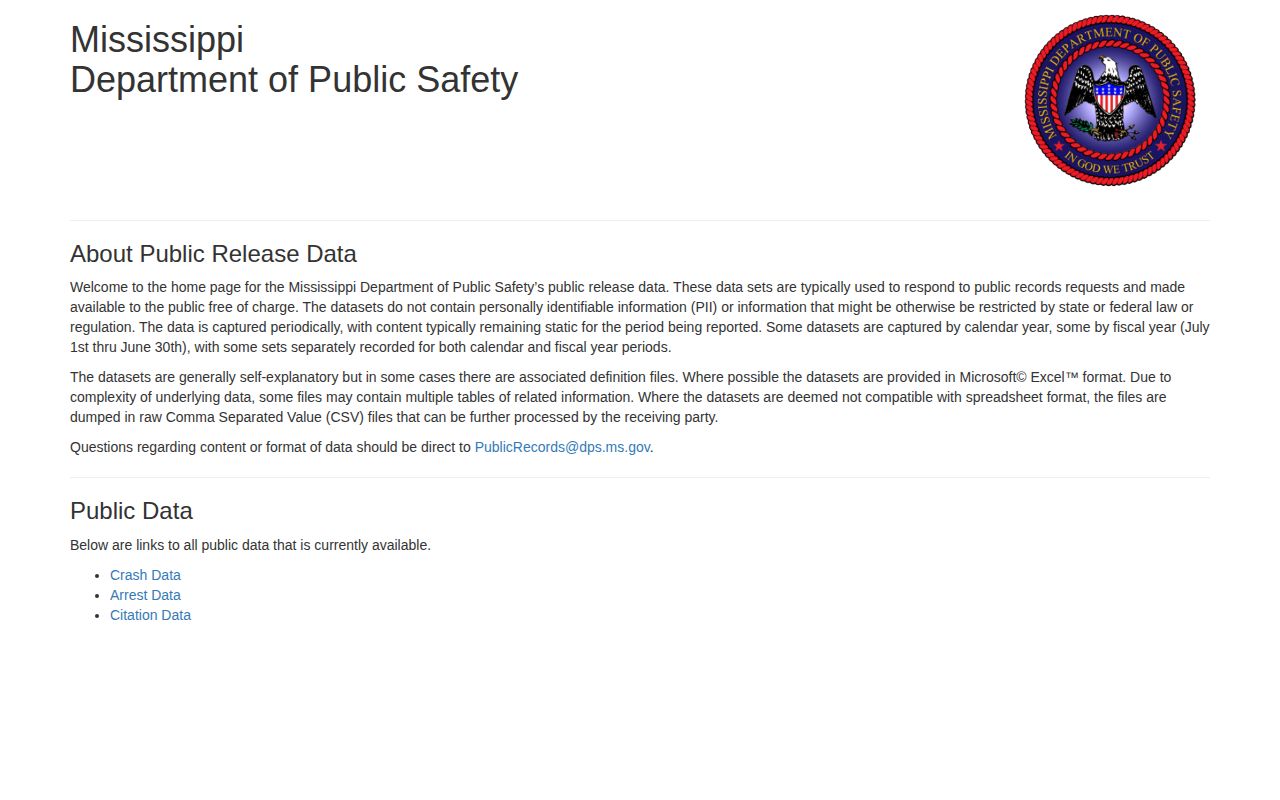
Statewide numbers are not a daily MHSP arrest count. They say nothing about one person's custody either. The Mississippi Arrest Log overview separates county records from state releases and news blotters for arrests spanning several days. Public-data downloads and safety reports cover trends and funded programs. Some identifying fields and restricted material never appear. Treat them as a view of enforcement priorities across Mississippi, then go to the county or court record for the single case.