
Mississippi Public Arrest Access
Mississippi law presumes records are open. Every sheriff must keep a public jail docket. That gives residents a way to trace arrests and custody even when a county posts no searchable roster online. Openness has limits, though. Not every booking photo or juvenile file is public. Access turns on the record itself, the person's age and case status, the holding agency, and any exemption or court order. The docket rule comes from Mississippi Code Section 19-25-63. The statute spells out a full history: the warrant or mittimus, who issued it, the person's name, when the sheriff received the person, and the arrest and commitment dates. It also covers the cause or legal authority, the length of hold, and the release or discharge. The docket passes to a successor sheriff. A public docket is not a promise of an online booking-photo site. The agency may redact any part the law protects. Redaction does not close the rest of the record.
- Jail docket
- The sheriff's required record of a person's custody and release history.
- Disposition
- The court's result in a case, separate from the arrest or booking entry.
- Expungement
- A court-ordered remedy that changes the covered official record under a qualifying law.
Mississippi Public-Records Rules
The Mississippi Public Records Act sits in Title 25, Chapter 61. The Commission's public-records summary recommends written requests. Absent a different written procedure, access is due within one working day. No procedure may stretch a response past seven working days. If the record cannot be produced by then, the agency must explain the delay. The explanation must be in writing. A denial must name the specific exemption claimed. Custodians must separate open material from protected material rather than sealing whole files by default. Denial records stay on file for three years. A reasonable fee is allowed. It is capped at actual cost for searching, reviewing, copying, and mailing. Staff time is charged at the lowest competent pay scale. Advance payment may be required.
| Request point | Mississippi rule |
|---|---|
| Form | Write to the agency or custodian that holds the record. |
| Usual access window | One working day when no different written procedure applies. |
| Outside limit | A procedure cannot authorize a later answer than seven working days; a delay needs a written explanation. |
| Partial release | Nonexempt material should be separated and released; a denial should name its exemption. |
The Commission's Public Records Act page lays out the law topics and its guidance for making a request.
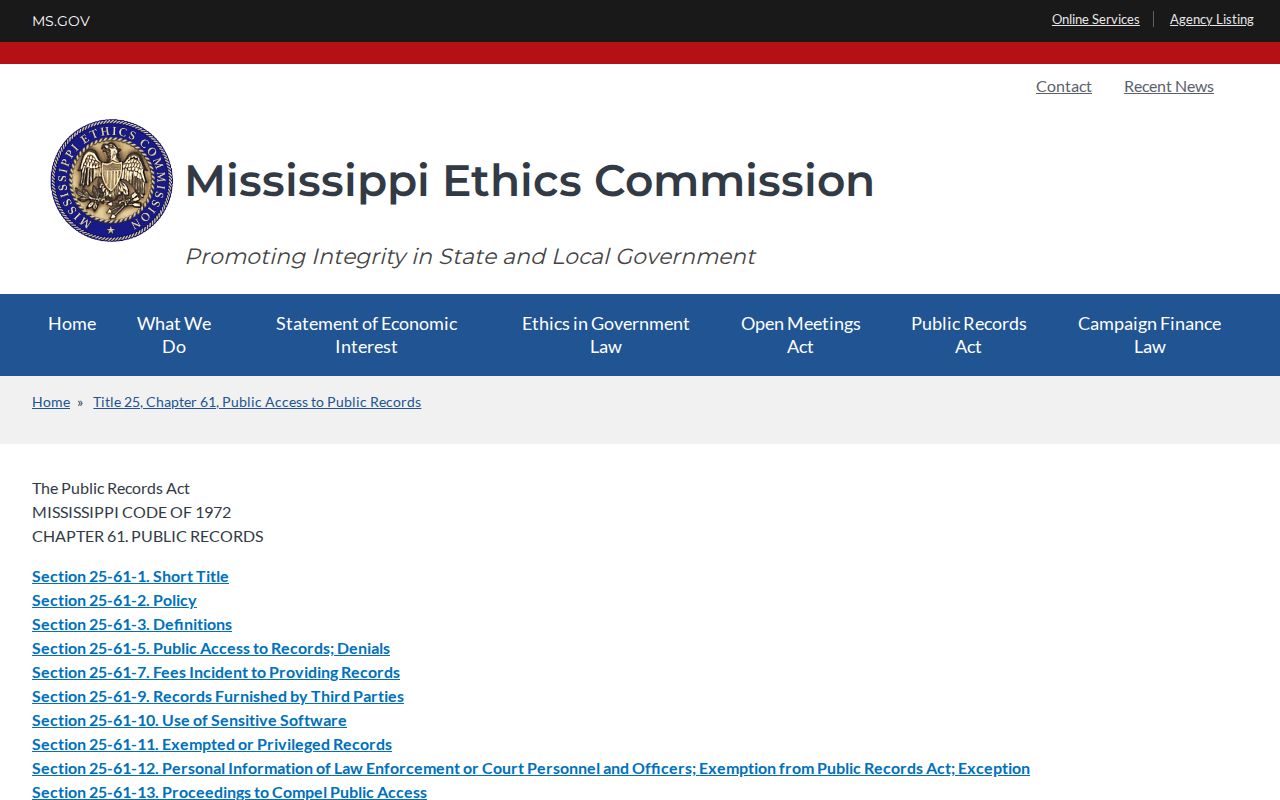
An arrest or incident report can come through the public-records process even without an instant online docket. The custodian may redact what the law protects and should explain the exemption used.
Note: A written request creates a clearer record of what was sought, when the agency received it, and how it answered.
Mississippi Misdemeanor Arrest Names
Mississippi Code Section 25-1-109 restricts what police may say about a misdemeanor arrest. The rule covers people arrested, cited, or held for minor offenses. As a general rule, no name goes out. The agency may release it only when the person is formally charged and arrested for the offense. Exceptions exist for law enforcement and certain protective or child-care functions. Check the charge and the agency's role first. This statute stands apart from the Public Records Act. A public docket does not mean every name on a booking screen can be published. The law dates to 1997. It was amended in 2023, effective July 1, 2023. When the offense level or charging status is unclear, ask the arresting agency how it applies Section 25-1-109 today. Separate criminal-information laws let DPS and the Justice Information Center collect fingerprints, descriptions, photographs, and identifying data. Security and privacy rules still govern sharing. The statutes on criminal-history information and agency fingerprints and photographs explain why a booking photo exists. Posting is a local choice. No state command requires an online booking-photo site.
Mississippi Juvenile Records Are Private
Youth records get far stronger protection than an adult booking record. Juvenile matters work differently. Section 43-21-255 makes law-enforcement records about a child confidential. Photographs and fingerprints are allowed only in narrow serious-offense situations. Sharing is limited to law enforcement, youth court, and appropriate school officials. The statute also restricts telling a private person or firm that the child exists, unless a specific legal exception applies. That bar is deliberately strict. A record can look like an adult booking and still involve a youth-court case. The agency and youth court control the current status. Only the custodian can confirm a public exception. Youth-court case files stay confidential under separate rules as well. Under Section 43-21-255, the narrow exceptions include a child convicted as an adult and a child twice adjudicated delinquent for a sex offense. That is not permission to republish a youth record. Sealing is a separate path. A youth court may seal records when statutory conditions are met, such as the child reaching the required age, a dismissed cause, or a set-aside adjudication. The details live in Section 43-21-263.
Where Mississippi Arrest Records Live
One Mississippi arrest can create several records. The sheriff keeps a docket of custody and release, the arresting agency files an incident report, the court holds the case file, and MDOC tracks any state custody or supervision. No county website shows all of it. The County Directory points to local sources, and the statewide index describes the photo and roster landscape.
| Record holder | What it can answer |
|---|---|
| Sheriff or jail | Booking and custody details, the public jail docket, and the agency's current roster if it publishes one. |
| Mississippi DPS | Public arrest, citation, or crash datasets and state-agency releases; not a county booking roster. |
| Mississippi courts | Case filings and disposition in a court that handles the matter; a court entry is not the booking record. |
| MDOC | State correctional custody or supervision, separate from a new county arrest. |
| Independent publishers and newsrooms | Copied or reported material that may be selective, incomplete, stale, or retained after the official source changes. |
The DPS public-data portal publishes arrest, citation, and crash datasets. The data arrive in batches, with personal details and legally restricted material left out.
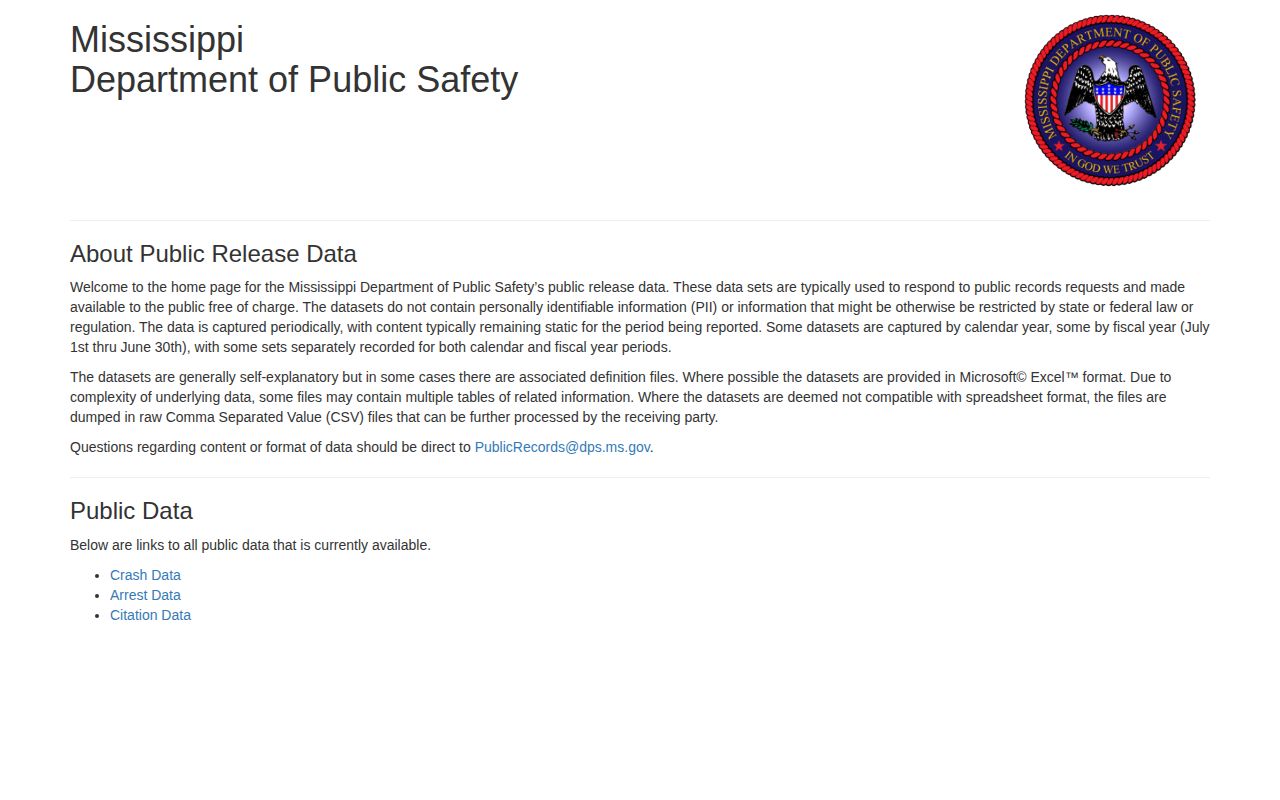
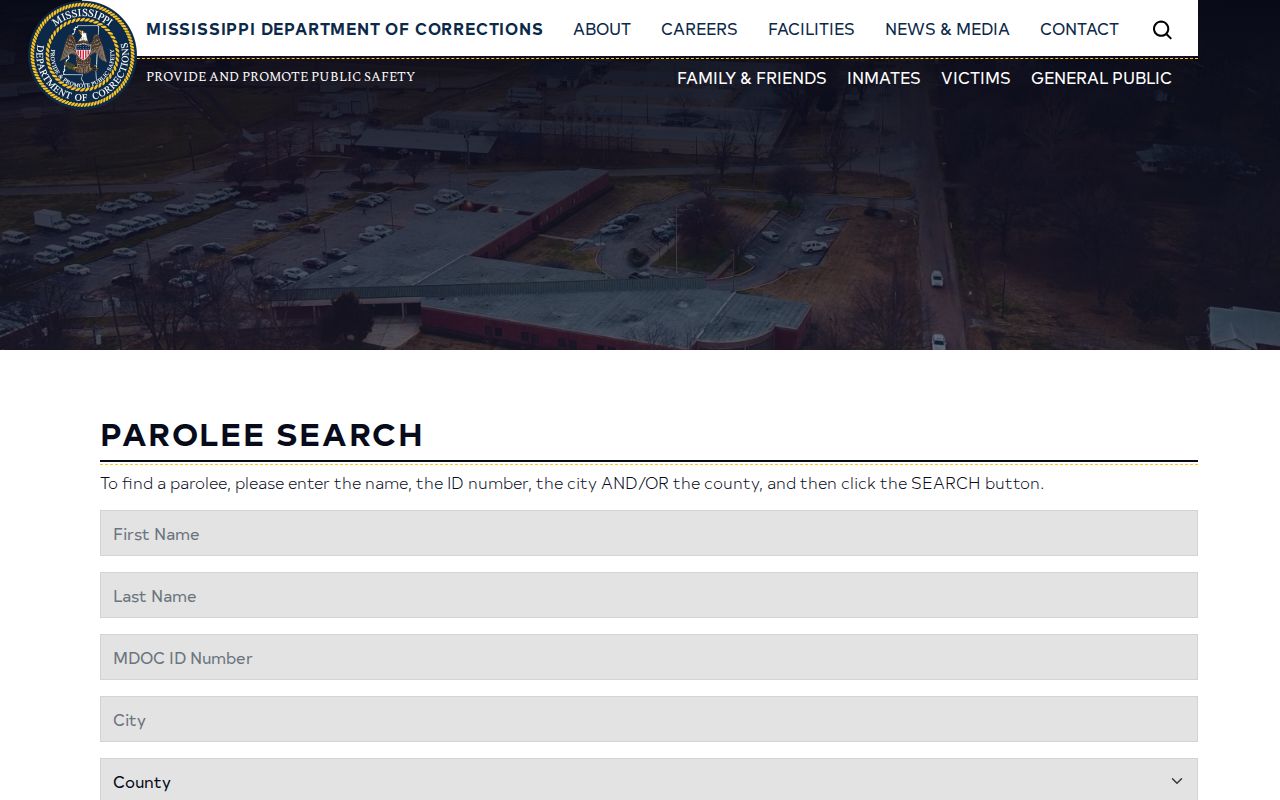
Those datasets are not a person-by-person arrest search. A county booking lives with the sheriff or jail. A case result lives with the court. The Mississippi Electronic Courts portal starts circuit and county case searches, yet it is not one free, real-time viewer for every local criminal matter, and access varies by court, case type, account, clerk, or copy request. The MDOC parolee search covers state supervision, not a new county arrest. It accepts a name, MDOC ID, city, or county. The same fields appear on the MDOC search interface.
News stories are not official records. Busted Newspaper, RecentlyBooked, Mugshots.com, Arrests.org, and Mugshots.zone are unofficial and vary by county, and Mississippi newsrooms report selected events rather than a statewide booking feed. Confirm copied material with the public custodian.
Mississippi Jail Records and Archives
A web page can vanish while the official file survives. The Mississippi Department of Archives and History's County General Schedule dated July 15, 2025 sets the retention period for each record type. The jail docket is permanent. That rule creates no separate permanent statewide booking-photo series.
Arrest reports are kept 75 years for felony arrests tied to crimes with no limitation period or death-penalty matters. Other arrests get 25 years. Offense and incident reports follow their own periods: 75 years for the comparable serious felony category, 25 years for other felony reports, and five years for other offenses. Jail census and meal logs last three years after audit release. Inmate case files last 25 years after release. Pre-1970 records need written MDAH approval before disposal.
A photograph generally follows the schedule of its underlying arrest, incident, jail, or inmate file. A more specific rule can override that. The permanent docket does not make every image permanent. A missing website entry does not prove destruction either.
MDAH's MDOC archival collection holds annual reports and a historical Parchman photograph booklet. The archive catalog lists historical series, not a current arrest feed.
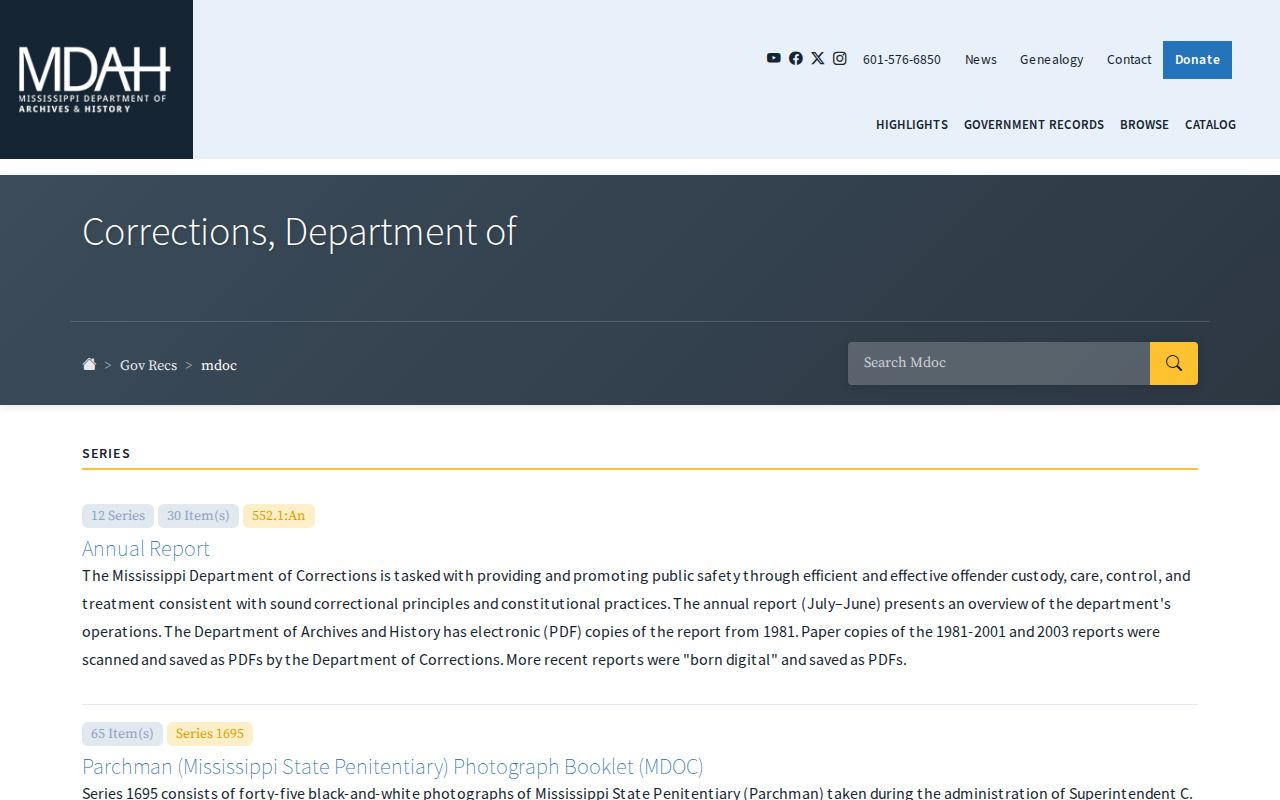
The collection serves historical research. It will not answer a current county booking or a gallery of recent mugshots.
Note: The custody docket, an arrest report, and a booking image can follow different schedules even when they concern the same event.
Mississippi Expungement and Photo Requests
Mississippi expungement is a petition and court order, not automatic deletion. A clerk or lawyer can confirm current forms, eligibility, service, and cost. The order covers official records. Private copies may need separate requests.
The 2026 framework cuts the wait for some eligible felony convictions to three years after sentence completion, down from five, with payment, rehabilitation, and other conditions attached. Many offense types stay excluded. Check the HB 1546 text and the court. Dismissed, dropped, no-disposition, and not-guilty cases have a separate petition route under Section 99-19-71. First-offender misdemeanors can use nonadjudication under Section 99-15-26.
| Path | What it can change |
|---|---|
| Correct the source | Ask the arresting agency or custodian to fix a factual error in its own record. |
| Petition for expungement | A court may order eligible official records restricted or removed under the applicable statute. |
| Nonadjudication or qualifying case outcome | Separate legal routes can apply after the required conditions or a qualifying dismissal, no-disposition, or not-guilty result. |
| Publisher request | Independent publishers offer free correction or removal requests under their own policies; a request is not a legal order or guarantee. |
| Search result update | After the source changes or vanishes, ask Google to refresh outdated content; the tool cannot decide a case. |
The fee in Section 99-19-72 is generally $150. The clerk can confirm the current amount and steps. Send the signed order to every covered agency. Publishers get the same order or correction proof, plus the exact page address.
The five major mugshot publishers offer free request paths under different policies. Requests may ask for a listing URL, contact details, a reason, and legal proof. News outlets have no common arrest-specific form. Use each newsroom's correction route with the article address and evidence. A lawful story may stay archived after a correction.
No single payment erases every copy. Mississippi has no statute forcing a private publisher to remove a booking photo for a fee, and no request guarantees that older screenshots or cached copies will vanish.
When a source page changes or disappears, Google's outdated-content tool can refresh the result. The tool cannot grant an expungement.
Note: A court order can guide a correction request, but a private copy may need its own request after the official record changes.
Why Mississippi Has No Removal Law
Mississippi has no statute aimed squarely at mugshot websites. No enacted law bars a private publisher from posting an arrest photo. A fee to take it down is lawful too. That gap does not authorize everything, of course. Rules on public records, name disclosure, privacy, and expungement still govern what may lawfully appear online. Juvenile, sealed, or expunged material stays off limits.
The state's safeguards sit in adjacent statutes instead. The jail docket requirement goes back to the 1892 code and was amended in 1994. Mississippi capped misdemeanor name disclosures in 1997, with a 2023 update. Appellate mugshot rulings, meanwhile, deal with evidence at criminal trials. They do not touch a publisher's removal fees. A 2026 clean-slate bill was introduced in the Legislature but never enacted. Treat it as a proposal, not a blanket erasure law.
Mississippi takes a different route than states with takedown laws. No statute here gives publishers a deadline to pull a booking photo. For a full picture of the state's photo landscape and lookup paths, see the statewide arrest index, which covers county rosters, court files, and independent publishers, each answering a different question about an arrest record.