
Mississippi Arrests Today Vary by County
No single statewide feed covers Mississippi arrests today. Each county holds its own booking and custody data. An online roster may say who is in custody now. It may say nothing about who entered jail yesterday. Adams and Pearl River counties offer the clearest same-day examples on the web. Wayne County provides date fields in an inquiry tool. That tool is a date query. It is not a true rolling 24-hour page. A "books 24hr" screen answers one question. A date range answers another. So do a current inmate list and a newspaper post. These examples simply behave differently. They do not rank one county above another. A county with no web view still keeps its official arrest records.
| County source | Verified same-day behavior | Fields and limits |
|---|---|---|
| Adams County Sheriff | Official jail portal has 24-hour and 72-hour variants. | Intake, release, and arresting-agency fields; photos appear where available. No dependable refresh schedule or archive promise was found. |
| Pearl River County | Official BlueHorse page labels a view “Books 24hr,” covering about the prior day. | Booking and release details appear, but there is no durable update time or archive guarantee. |
| Wayne County | Official Inmate Inquiry has booking date range fields. | Name, subject number, booking number, and custody status are shown in the interface; the form is not labeled as a 24-hour feed. |
| Other current-custody pages | Some county sites expose current-inmate tables or vendor searches. | Unless an intake date is visible, current custody does not establish a same-day arrest. |
The Adams County Sheriff portal shows how one county's same-day view works. It can display intake time, arresting agency, charge wording, and release status where supplied.
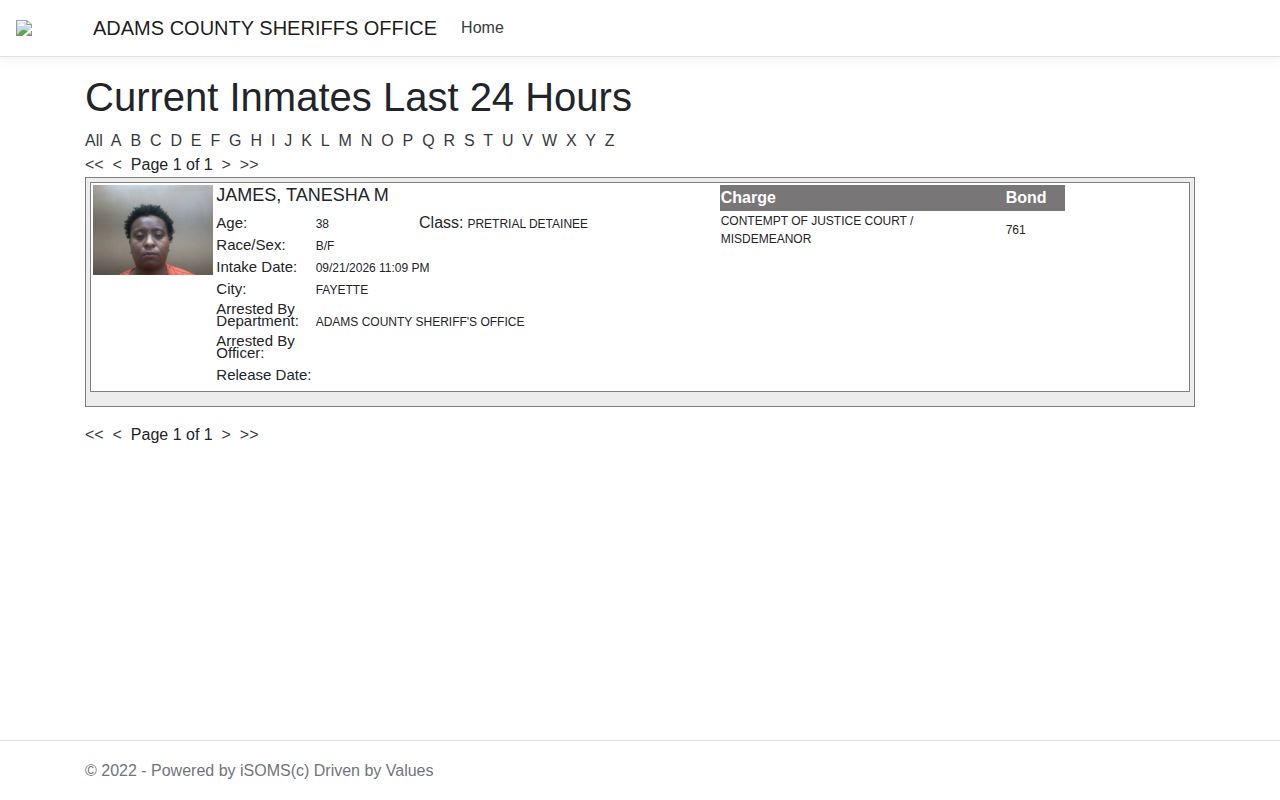
That interface covers one county only. It is not a statewide roster. Its fields show what the source actually reports, and a new booking may take time to appear.
Fields in Mississippi Same-Day Arrest Views
Field names differ across jail systems. Booking means the jail's intake and processing of a person after arrival. The state's jail-docket law sets a broader recordkeeping floor than any one screen: each sheriff keeps a history with the person’s name, the warrant or commitment source, arrest and commitment dates, the cause or authority, time held, and release or discharge information. An online card may show only part of that record, and a photo may be absent even when a booking exists. The Pearl River interface provides a clear example of a “Books 24hr” label, but the label does not replace a timestamp or a written archive policy. A booking number or subject number can help distinguish people with similar names; if the source has no unique identifier, confirm through the named county custodian.
| Field | What it can show | Statewide caution |
|---|---|---|
| Name | Person listed in a booking or custody entry. | A name alone may not prove identity; use a booking or subject number when available. |
| Booking or subject number | A portal identifier tied to a record. | Availability varies by vendor and county. |
| Arrest or intake date | When an agency reports the arrest or jail intake. | Arrest and commitment dates are not always the same event or time. |
| Arresting agency or authority | The department or legal process tied to the entry. | It does not identify the court's final ruling. |
| Cause or charge wording | The stated basis for custody or charge. | Charges can change; they are not a finding of guilt. |
| Custody and release | Whether the person is listed in custody and any release detail shown. | A page can lag behind the jail's live status. |
The Pearl River County Books 24hr view is a vendor interface. It carries booking and release fields. It does not promise that every Mississippi county uses the same system. Mississippi Code Section 19-25-63 makes the jail docket a public record. That law does not force a searchable website. It does not require a booking photo either.
Note: A field absent from a public screen may still exist in the custodian's record and may be subject to redaction or an exemption review.
How to Check Mississippi Arrests Today
Begin with the county tied to the arrest or jail intake. Then use that county's own official source. A municipal officer or Highway Patrol trooper may make the arrest. The booking still lands in a county jail. Never assume a statewide press release or data portal will carry a name. The photo may not appear. Custody status may be missing too.
- Identify the county. Use the known arrest location, arresting agency, or report details to narrow the likely county. For a Highway Patrol arrest, look for the county named in an official release or ask the responsible agency where the person was taken.
- Open the sheriff or jail source. Use the County Directory from the site navigation to reach the county's official page. Check whether it offers a labeled same-day view, a booking-date search, or only a current-custody roster.
- Read the time field. Compare the arrest or intake date with the time the page was checked. A date-range search can show several days, while a current-custody list can omit people already released.
- Confirm a missing or unclear entry. Contact the originating records custodian or sheriff's office. If an online roster is not available, send a written public-record request that identifies the person, date range, agency, and record sought.
The right county matters more than a broad name search. The statewide Weekly Arrest Log describes the multi-day record landscape, including county blotters and archives. Those sources stay separate from any same-day jail view.
Why Mississippi Booking Times Lag
An arrest, arrival at jail, booking, and public posting are four separate events. Staff must process the person and enter the data first. Only then can a vendor screen display the record. Each source refreshes on its own schedule. No refresh guarantee exists. That applies to the Adams portal, the Pearl River view, and the Wayne inquiry screen. A date query may also make you set the range yourself. A current-custody result answers one narrow question. It shows whether the portal lists someone as held at that moment. It may omit a person booked and released before your search. A record still visible may not reflect a later release. A name-only result is just a lead. Verify it. This matters most where the page lacks a date of birth or a unique record number.
Mississippi's Public Records Act offers a written-request path when a screen is missing or unclear. The agency may review exemptions and release the nonexempt portions. A web roster is never the entire record.
Note: A county portal's last visible entry is not an official statement that the jail has no newer booking to process.
Misdemeanor Arrest Names May Be Withheld
Mississippi draws one firm line around misdemeanor names. Section 25-1-109 bars release of certain names. It covers anyone arrested or cited for a misdemeanor, or held on one. The name can come out only through one route. The person must be formally charged and arrested for that offense. Exceptions exist for law-enforcement work and certain protective functions the statute lists.
This limit is not the same thing as record secrecy. A sheriff may keep the booking entry on file. Yet the name may still be withheld from a public post. The charge level or charging status is not always obvious. Ask the agency which record exists and which rule applies.
Never fill a blank name from social media. A third-party claim proves nothing about the arrest record. Only the original custodian can tell a delayed entry, a lawful withholding, a wrong match, and an unreleased record apart.
Note: Mississippi's misdemeanor-name rule is a disclosure limit, not proof that an arrest did or did not occur.
Juvenile Records Stay Outside Arrest Feeds
Juvenile records sit behind a much thicker wall than adult bookings. Under Section 43-21-255, the rule is confidentiality. Law-enforcement records about a child are generally confidential. Disclosure to private people or firms is limited to narrow statutory exceptions. A child's photo or fingerprints may be handled in specific serious-offense situations. That still creates no ordinary public feed.
An old screenshot or an adult-looking booking page proves nothing about access. Sealing can also apply through Section 43-21-263. Only the current youth court or an authorized custodian can confirm a lawful public exception. A statewide same-day page should never carry a juvenile name. That goes for an image or identifying detail too.
This boundary explains why online cards cannot be counted as a full measure. Some records are legally protected. Others simply go unposted. Neither gap turns a public webpage into a complete account of Mississippi arrests.
Photos and Mississippi Jail Dockets
Mississippi law does not require every adult booking photo to appear on the web. Access varies with the custodian, the record, and any exemption or court order. The state's criminal-information statutes let agencies collect photographs. But collection authority is not a command to publish each image. A missing photo does not disprove a booking.
The docket and the web view serve different purposes. The county retention schedule comes from the Mississippi Department of Archives and History. Under it, the jail docket is permanent. Arrest reports follow separate retention periods by category. That includes 75 years for specified felony arrests and 25 years for other arrests. None of this keeps every mugshot online forever.
Requests go straight to the sheriff, jail, or agency holding the record. Name the person and the date or range. Add a case or booking number if known, plus the exact record needed. The Public Records Act permits reasonable actual-cost fees. Advance payment can be required. Where no other written process applies, the Ethics Commission calls for access within one working day. A written explanation is required if production slips past the seventh working day. If part of a record is withheld, ask for the segregable nonexempt material.
A disposition is the court's recorded outcome in a case. It stands apart from the jail's release entry. The Ethics Commission's Public Records Act guidance explains the request rules, so seek the official record from its custodian and verify any later court outcome on its own.